Saturday, February 24, 2007

Journal: "New Translations"


A new journal affiliated with the Comparative Literature Department at The Graduate Center of the City University of New York has released a call for submissions for its first issue. New Translations invites submissions of newly translated and retranslated works of literary, historical and philosophical merit as well as reviews of recently translated texts. Inquiries may be sent to submissions@newtranslations.org.

From the Blumies: what, in the minds of the editors, constitutes merit? It's a challenging question, but one that deserves no less priority than the accuracy or elegance of the translation. That a translation is well-executed does not neccesarily mean the content of the source text is well-written or well-conceived! I look forward to seeing how the editor's emphasis on judging the value of the original is realized in publication.

Thursday, February 08, 2007

Rosanna at Work

In an article from BU Today, the community news site for Boston University, Professor Rosanna Warren advances an uncontroversial but largely unheeded proposition: “You can be word-by-word accurate, but produce an absolutely horrendous translation that has no life in it." The article is a genial introduction to a writer whose poetic sensibility is central in the American writing community, and whose lyrical intelligence has had wide influence, not the least reason for which is her celebrated Literary Translation Seminar in the University Professors Program at BU.

In the seminar, students gather on Mondays for classroom sessions under Prof. Warren's able direction, discussing the challenges and techniques for depositing the gold of one language in the treasury of another. On Fridays, expert practitioners are flown in to discuss their chosen art. Already this spring, Robert Hahn has spoken on translating from English to Italian and from Italian to English, and Roger Greenwald came down from Toronto to share his expertise in editing and translating work from Norway and Denmark. Looking ahead, I'm personally excited to hear Richard Serrano's lecture titled "Translating Traditions in Chinese and Arabic Poetry: Al-Akhtal and Sun Yunfeng" on February 16. For a full list of this semester's lectures, visit the seminar webpage.

Professor Warren is given rein to say altogether more interesting things in a 2005 interview from The Kenyon Review. Interviewer Joseph Campana asks about an attitude found in her essays about Sappho and Catullus: "that poetry is, inherently, both elegy and translation." Asked to speak more about this, she responds:
... "I think of poetry as being lyric in the deep and archaic Greek sense, as song and dance. By the time it is translated to the drawing on the page that we call writing, the markers of dance and song are no longer present. Writing tries to conjure the presence. In that sense, I think of poetry as a kind of elegy for that transient intensity of experience. And translation, more specifically, sacrificial and elegiac in that it takes you to the heart of the mystery of what is poetry, which nobody can define, but we keep dancing around it. It’s an essence, which is not just engineering, which you can't just get by riveting together choriambs or dactyls, and yet which involves the engineering at some level. The image of the human body is a good one since most of us have the illusion, at least, that who we are is not merely the engineering of our bones and flesh and nervous system, though we wouldn't be here without them. So translating means teleporting a body, teleporting Sappho into another body. Inevitably in that passage, the molecules, the cells are damaged and yet we reconstitute it in something like a good translation which gives us the illusion of another dance being made, another breath being breathed, another nervous system pulsing.
Elsewhere in the interview, readers will learn about Warren's traditionalist stance on the education of poets and translators, an ethic enacted in the translation seminar's emphasis on metrics and formal verse in Greek, Latin, French, and Italian, among the many languages held up for consideration.

Links:
WBUR "World of Ideas" with readings
Translations of imaginary (!) French poet Anne Verlaine
Faculty Profile at Boston University

Sunday, January 14, 2007

Chicago Translation Symposium

Featuring an unusually interdisciplinary schedule, the 2007 Caxton Club/Newberry Library Symposium will be held on March 31, 2007, under the title "Remodeling the Tower of Babel: The Translator's Role in a Shrinking World." The program is available at the website of the Caxton Club of Chicago. Translators and others with a professional interest in translation who would like to discuss the possibility of a caravan expedition from Boston to Chicago, are encouraged to contact the Blumies by email.

Of particular interest to this Blumie is the panel discussion to explore "the future of translation and translation studies, which seem inevitably linked to the ongoing development of the Internet and of digital translation technologies. This question will also be taken up in the Fall 2007 issue of the Journal, by Chuan Summers at the University of Leeds. In his article, Summers considers the merging methodologies of machine translation, corpus tools, and the traditional exertions of the human practitioner. He advocates ultimately for the integration of these disparate elements. As the demand for translation of print and digital works continues to rise, translators can either embrace all available methods in order to provide efficient and competent versions, or can stake out differing claims on "legitimacy" that impede the collective effort to disseminate literature across linguistic and culture boundaries.

Saturday, January 06, 2007

Manga and Scanlation

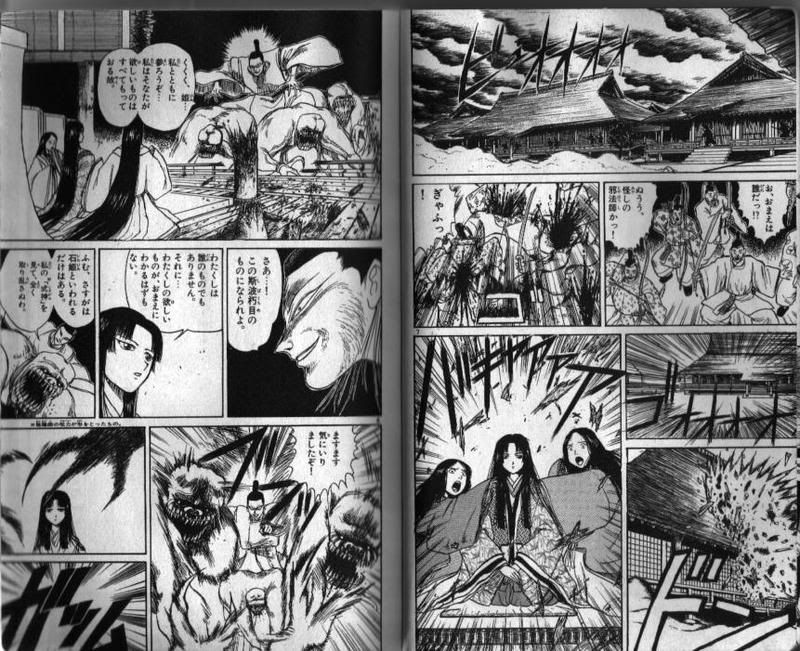
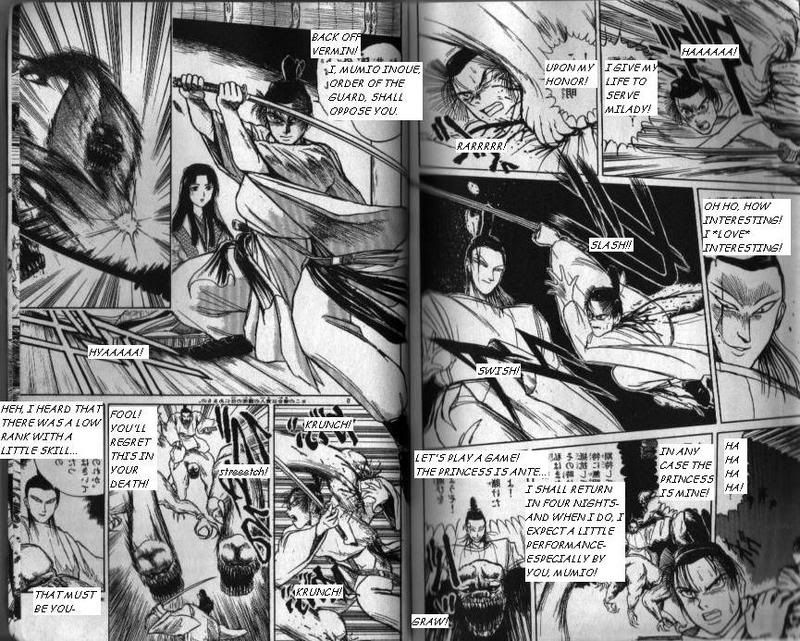
There’s been a lot of positive feedback on Dygo Tosa’s translation of “Snowfall” from Kazuhiro Fujita’s Ushio to Tora Gaiden. Several folks have written in to tell us more about scanlation, in which amateur translators "dub" the scanned pages of a manga with new text; the product is distributed by the same file-sharing techniques employed by music fans to download illicit tracks.

Manga publishers are not meeting the market demand for translation; fans who’d like to get their hands on a particular title are forced either to learn Korean or Japanese or turn to underground sources whose reproduction of source texts is illegal under current copyright statutes. The language barrier discourages Asian publishers from printing English-language editions; yet surely they can’t be content to watch their copyright be disregarded by eager scanlators! Readers with legal perspective are invited to share their two cents on this dynamic literary situation.

Mr. Caxton – an online persona of veteran manga translator Toren Smith – argues in his blog The Dead Zone that scanslation is not a benign form of reader enthusiasm:
I know from talking to many folks in the industry that scanslations DO have a negative effect. Many books that are on the tipping point will never be legally published because of scanslations. This is not only unfair to the honest fans, it is robbery from the very creators the otaku profess to love.

And yes, the neo-otaku (my neologism for the new generation of entitlement-minded and puritanistic manga and anime fans) have mutated into a truly awful bunch of people, which is part of the reason I dropped out of the biz. Why work twelve hours a day, seven days a week for such an audience?
Scanlation ProcedureAlthough they scanlate at their own risk, this fan community is thriving and well-organized, with devoted Spanish-language and German counterparts. The German site Eyeshield21 uses a flow-chart to illustrate their scanlation process (translated here for the convenience of monoglot readers).

The globe-spanning technology that allows the easy interchange of foreign language literature also enables piracy. Or should we consider scanlation a new form of samizdat, being fundamentally a response to the lack of access to literature? Though of course this lack is caused not by censorship but by the laggard pace of publishers in keeping up with their web-savvy readers. As with illegal music downloading, as bandwidth increases so does the tension between publishers and consumers ready to turn to alternative sources for their favorite manga. It’s my opinion that cease-and-desist orders and the threat of lawsuits are not the right way to resolve this burgeoning conflict. After all, authors and artists should be delighted to have readers so eager for the story that they to their own scan optimization, image retouching, research and translation! Let us see.

Turn to The Comics Journal for a discussion of the scanlation phenomenon from July 2005. Blumies who want to learn more can explore del.icio.us tags on the subject or can visit MangaBlog for a good introduction to all things manga.

Thursday, January 04, 2007

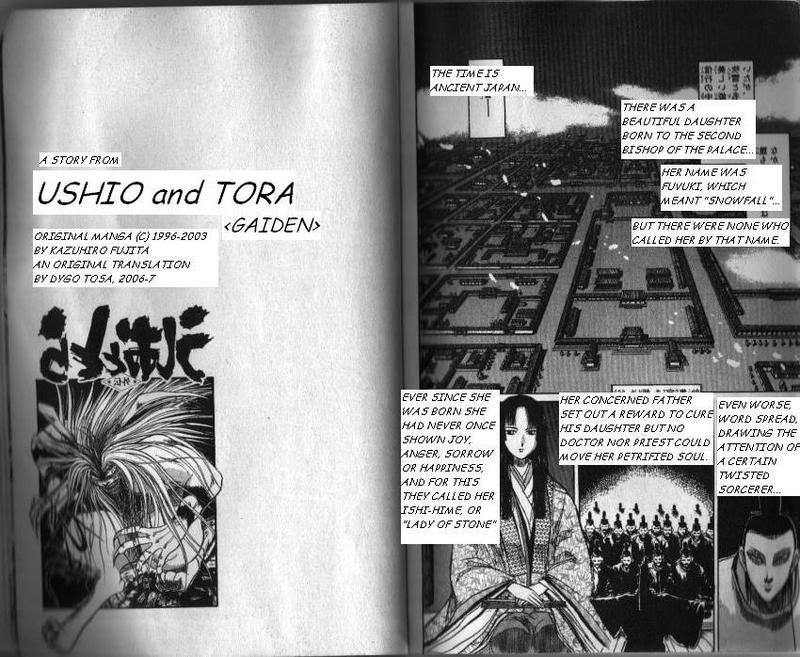
"Snowfall": An Original Manga Translation

Photobucket - Video and Image Hosting

"Snowfall" from Ushio and Tora Gaiden
A Manga Translation by Dygo Tosa
Original Manga (c-Japan) 1996-2003 Kazuhiro Fujita


I've spent the past two weeks translating one of my favorite mangas, "Ushio and Tora." I started reading the series back in middle school and I've loved it ever since; while the series ended years ago, I am still trying to collect all of the episodes. To my knowledge, none of the printed manga have ever been published/sold in the United States. Here, I've tried to put together points about translation and other notes so that reading the translation will both be more enjoyable and meaningful. Let me know if you have any further questions -- or even "worse" -- translation requests! My email for this project is tosa.dygo@gmail.com. Thanks for reading!

An Introduction to Manga
You are about to step into a dark, scary and also very cheerful world of Japanese manga, but there's always something to be gained in seeing the world through another man's (or woman's) eyes. Mangas are Japanese comics and cartoons; the different genres and characters of manga are as diverse as what you might find in the Sunday newspaper to the cult follower's comic shop. I grew up with mangas and Japanese so reading them is no difficulty for me, but it takes a lot of learning for a gaijin ("foreigner") to pick up on reading a manga to the fullest. First of all, Japanese mangas are very much like their American counterparts in that they draw upon both common and obscure references. Many translated mangas will need to either omit or explain seemingly strange facts and behaviors which would be perfectly normal for a Japanese person. One memorable scene comes from the popular children's show "Pokemon," when the Pokemon pets are chewing on onigiri riceballs. The translators adeptly called them "jelly-filled doughnuts"; a clever translation that neatly explains the red center (onigiri are filled either with salmon or pickled plum). Since Japanese culture has embraced much of American culture (and not as much of the other way around), it's difficult for me to find a good reverse analogy; perhaps American Revolutionary and Civil War references would require some level of explanation for a Japanese audience. Pokemon being an example, many Americans are more familiar with "anime" than with manga, but most if not all anime originated as manga. There are some exceptions to the rule, such as Miyazaki's feature films like Nausicaa of the Valley of the Wind. Some differences with American comics include the fact that most manga in Japan are published as weekly collections rather than single issues. In the U.S., the imported and translated Shonen Jump Magazine is representative of a number of weekly manga publications in Japan. But like American comics, the episodes are collected by series and later published as anthologies in bookstores. More translations of manga and comics are appearing in American bookstores these days under the category of "graphic novel" which is a more correct term for the longer and more serious works. While I suggest a "try before you buy" approach (try borrowing from a friend!), since manga appeal to different tastes, if you've never read a manga series, I hope this encourages you to start.

About "Ushio and Tora"
"Ushio and Tora" by Kazuhiro Fujita is a epic series centered around an adolescent boy (about 14 years old) named Ushio who stumbles across a monster living in the storehouse basement. The monster, named Tora, happens to be a demon who had been sealed there a few hundred years ago. Did I mention Ushio lives in a temple with his dad, who's a exorcist priest? The story takes place in modern times though, and with Tora's awakening, other demons in the area start to appear and their adventures begin. Ushio must team up with Tora to protect his classmates, friends and even strangers from the paranormal. While typical of manga to be centered around high school age kids, the people they meet and the monsters they defeat are by no means ordinary. What sets "Ushio and Tora" apart from other manga is a brutal bluntness and sincerity, as well as wholesomeness, of Ushio and his allies. In the late 80's to early 90's mangas were plagued with depressing storylines and twisted perversities, and Fujita's style attempts to visually and literally destroy these perversions. The manga itself is visually R-rated for excessive violence, lots of blood and ink smears, nudity, and in translation, language.

The "Ushio and Tora Gaiden" is an epilogue written by Fujita to explain some of the untold stories in his series, exploring characters' pasts in the context of Japanese historical and literary tradition. For example, one of his tales borrows a chapter from the classical "Tale of Heike", that of the story of Tomo-e, the only female warrior remaining with the Genji warlord Yoshinaka in his final stand. I do not know from which classical story "Snowfall" was adapted but the reader should be aware it may not be entirely in keeping with the original. "Snowfall," by the way, is my own title to the story.

Opening Notes
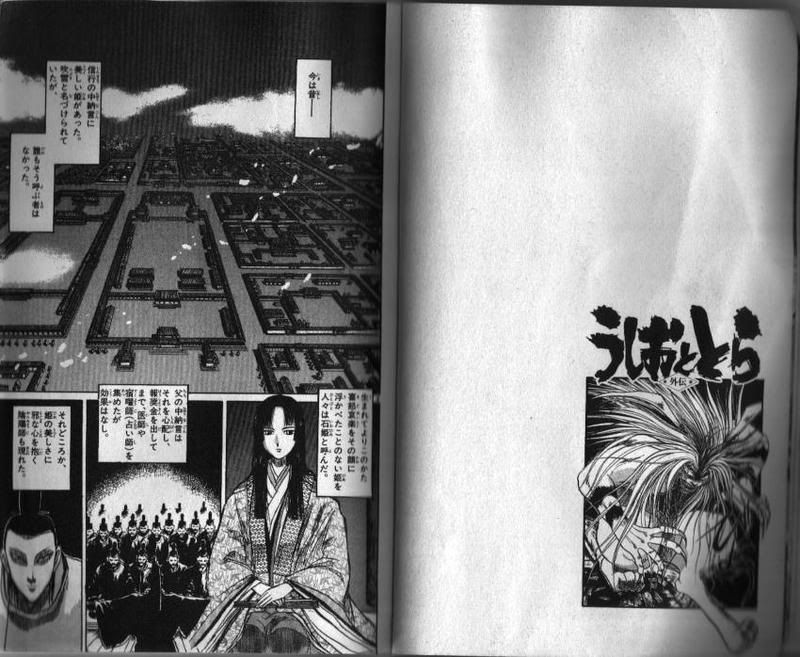
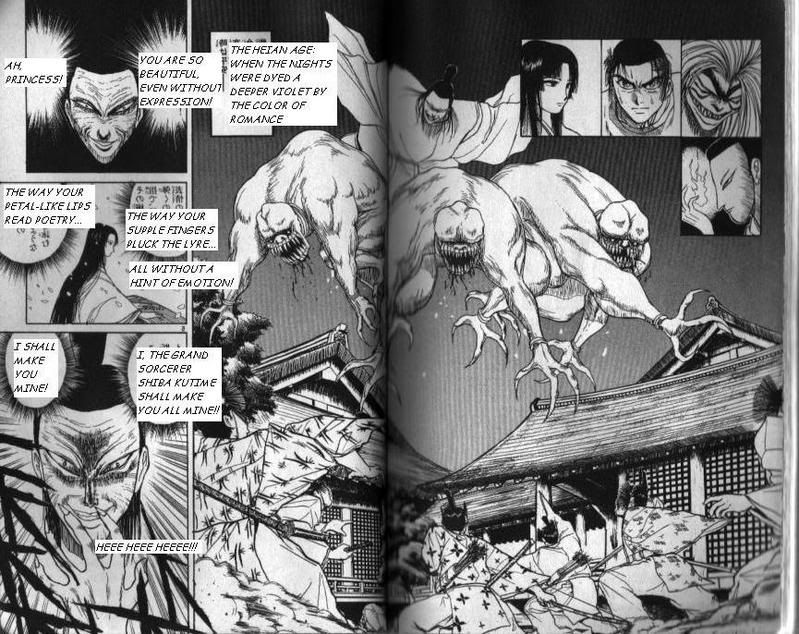
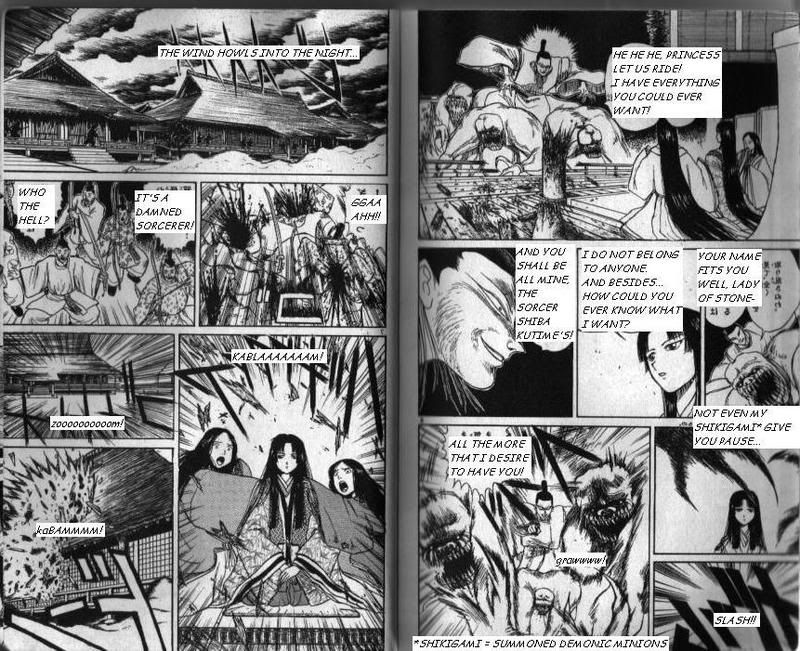
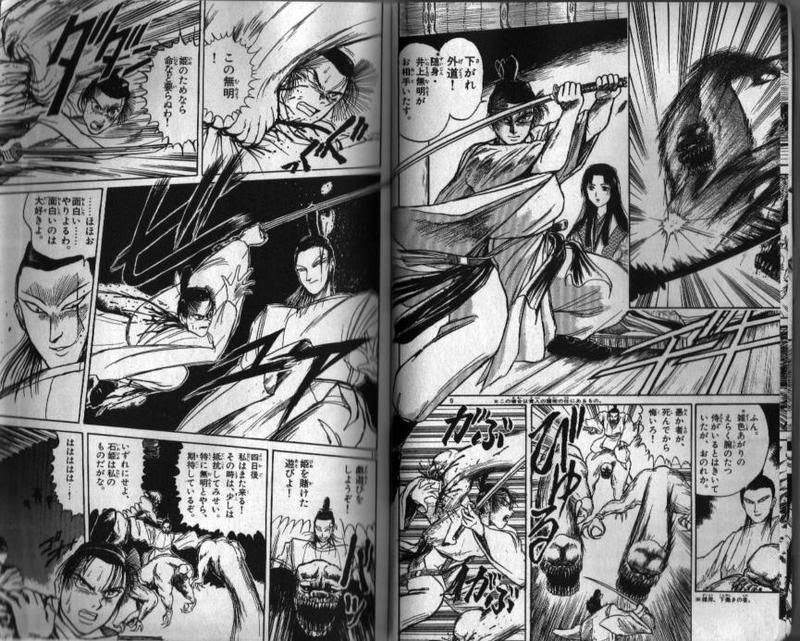
Japanese is read top-to-bottom, right-to-left. Hence the pages in translation have been mirrored so that a reader can follow the story left-to-right as with any conventional English language comic book. I regret having whitebox lettering since it obscures some of the art, but this was easiest for me to get all the text in. Again, the following content is R-rated for graphic content and some language.

Links to pages (hosted by Photobucket):

Translated Page 01 Original
Translated Page 02 Original
Translated Page 03 Original
Translated Page 04 Original
The additional pages have been translated, but are currently unavailable pending copyright/distribution permission. I apologize for this delay.


Notes
One of the biggest challenges in bringing Japanese manga to English is translating onomatopoeias. Sounds common to Japanese readers can be alien and difficult to express in English, for example: the howling of the wind ("go!"), the murmur of the crowd ("zawa-zawa", "hiso-hiso"). In each of these cases it made more sense to write up a description rather than attempt to reproduce the sound. Explosions had to be changed; in Japanese, "don!" represents an English "bam!". And Japanese can describe footsteps ("dodododo" and "tototo") but English lettering just doesn't seem right. Even musical sounds, such as those of a lyre (which is the traditional koto for those more knowledged), I couldn't use the Japanese sounds: "jyonnn" may be closer to the actual instrument's sound, but "bing" will sound truer to the English-speaking reader for a string-based instrument. I've seen translation of Japanese Noh-genre plays that retains the phonetic spelling of the original Japanese, but for my own translation I opted for familiarity. I tried to make the manga as a comic book, since I thought that would relate best to an American reader.

Recreating the distinct voice of each character is a huge challenge in any translation. I admire Fitzgerald's Odyssey for mastering this challenge, allowing Nausicaa's pouting and gradual maturation speak as vividly about her character as does the Cyclops' bumbling care for his sheep. In my effort to carry over the unique voices of the original, the monster (who is actually Tora from the series) should have a bad-ass attitude, while Mumio retains the sincerity and wholesomeness that is found in the series' Ushio. A lot of the dialogue in the original manga is written in a slightly archaic dialect, but conveying this without caution could have laden my text with a clumsy, anachronistic tone. In several places I experimented with "thee" instead of "you" but for the most part "you" had a more correct sound without being unduly modern, and I changed them to the "you" translation.

The texts of the Japanese Buddhist religion are written in ancient Chinese, just as Christian bibles and chants are chock full of Latin. To ensure that even arcane references would be somehow accessible to my English-language reader, I have used Latin equivalents for the three spells that appear in this story. The first was the easiest; I replaced "Koku" with "Victanda," a gerundive neuter plural (for the curious, my reasons were that the neuter gender would give a sense a generalness and the gerundive is slightly substantive). The second spell, Kamo's rune, is a fictional mishmash of Chinese characters and brush strokes. Hence the Latin includes gibberish as well as some real words. The last spell, the Zodiac sign, plays on resemblance of the Chinese "gon" with the English "begone." The twelve Zodiac signs are thought to be imbued with magical powers; the character "gon" is a north-eastern direction between the sign of the bull (Ushi) and tiger (Tora). The "Ushio" and "Tora" names are probably not a coincidence!

The names have not been retained exactly by the standard of Roma-ji, that is, the conventional system for transcribing Japanese phonetics into the Roman/English alphabet. Where I use "Fuvuki," "Mumio," and "Shiba Kutime," a stricter adherence to the Roma-ji system would form "Fubuki," "Mumyou," and "Shiba Kuchime." I hope my renderings are more stylized and easier to reproduce the sound of the original. I especially thought about Mumio's, since Mum-you doesn't really sound too tough. Lady Fuvuki's name also doesn't exactly mean "snowfall" but rather "blizzard." I've compromised the exact literal meaning of the word, since in my own reading the gentle nature of the character (although she seems at times emotionally callous) would be distorted by the name "Blizzard." Mumio's name means "without light." I was tempted to change Shiba into Shiva to invoke the Hindu goddess, but decided that would be taking far too much liberty in association. Kutime means "rotten-eye." These names could be Latinized like the spells, but that's a direction that I didn't take here.

In addition to any comments you'd like to share here on Boston Translation, I invite you to send any questions and inquiries to tosa.dygo@gmail.com.

Some Further Links
Wikipedia reports an anime version that was released in the U.S. The overall reports are not very good, especially for excessive, unnecessary violence and I don't recommend it. I have not seen them myself, so I do not know how faithful they are to the manga. The Wikipedia article is here: http://en.wikipedia.org/wiki/Ushio_and_Tora.
Japanese Wikipedia article on Fujita Kazuhiro: http://ja.wikipedia.org/wiki/%E8%97%A4%E7%94%B0%E5%92%8C%E6%97%A5%E9%83%8E
According to the article, Fujita won the Shogakukan Manga award in 1992 for "Ushio and Tora", and later received a Seiun (Nebula) Award for the same series in 1997.
Lastly, here is a link to the Japanese publisher's profile on "Ushio and Tora" (Shonen Sunday Comics): http://websunday.net/museum/no01/no01.html.

Again, thanks for reading!

Wednesday, January 03, 2007

Call for Submissions: "Translation"

Interdisciplinary Humanities Center
Translation, the new translation studies journal from the Translation Studies Research Focus Group of the Interdisciplinary Humanities Center at the University Of California, Santa Barbara, is now accepting submissions of poetry or short fiction translations into English and essays concerning literary translation. The following guidelines are taken from the journal website.
Only unpublished translations will be accepted. The journal is collaboratively run by graduate students and faculty, and welcomes translations from both new and established translators. Please email a brief bio of the translating author along with your submission to ucsbtranslation@gmail.com. All submissions should use current MLA formatting where required.

Poetry submissions should be limited to 3 per entrant. Poetry translations may be to or from English and should be submitted along with the original text for side-by-side publication. For short fiction submissions, 7-10 pages is the preferred length. Translators should obtain necessary permissions for translating texts and will be expected to assist in obtaining permission for publication of originals in the case of poetry. As a non-profit scholarly journal, Translation does not offer payment for submissions. Submissions will be accepted no later than January 10, 2007.

Farsi Kafka and Hindi Brecht

The Goethe-Institut is Germany's state cultural institution. As part of its mission to "promote the study of German abroad and encourage international cultural exchange," GI offers grants to support the work of translators who translate German literature into other languages, a program that is only one of the reasons the Institut is a model for other nations that seek to integrate their national culture into the world community. According to the information available on the organization's website, for the nearly thirty years that the subsidy program has been active GI has sponsored the publication of nearly 4,000 books in 45 languages.

In 2006 alone, GI funded the translation 236 titles including Nietzsche in Ukrainian and Polish; Goethe in Lithuanian, Indonesian, Albanian and Croatian; Kafka in Farsi; and Brecht in Hindi. Contemporary writers are support as well, e.g. the translation of W.G. Sebald into Brazilian Portuguese and Galician, and acclaimed author Ingo Schulze into Rumanian, French, Greek, Italian and Dutch.

Translators interested in investigating this funding opportunity should be advised that the program supports book-length projects only. Information about conditions, application, and contacts can be found online.

Helpfully, the Goethe-Institut has assembled a directory of links to other grant sources for translators. Readers in the Boston area can join the GI mailing list so to be notified when the Boston branch office is hosting another of its many cultural events. Of course, not all of our readers are in Boston; luckily GI has locations all over the globe.

Is there an agency of the US government which has taken up the banner of cultural diplomacy? The clearest analogue I see -- and my knowledge of the federal bureaucracy is acutely lacking -- is the Bureau of Educational and Cultural Affairs, a unit of the Department of State, specifically the Cultural Programs Division. I invite readers with greater knowledge such programs to share what they know. Is there a Henry James Haus in Berlin? Are there government-funded Twain Institutes? It's not unlikely the US government balk at the likely criticism of its ostensibly hegemonic aspirations. The Cold War era Congress for Cultural Freedomwas arguably a very successful program, but the backlash against state intervention in the arts surely still stings. I fail to think of any credible way to be similarly suspicious of the Goethe-Institut; after considering the distasteful question of the policy being GI, I conclude that it is a politically benign effort if it is at all political.

Tuesday, December 19, 2006

The Example of the Wet Floor Sign

Wet Floor!
The Spanish text on a janitorial sign, "Cuidado piso mojado," rhymes elegantly. However, the English version "Caution: Wet Floor" preserves neither the rhyme nor the rhythm. Why should one linguistic cohort enjoy tightly crafted service messages, while English-speakers have to make do with flat, literal admonitions?

Editor Matthew Kelsey suggests as an alternative: "Caution, we're washin'."

The moral of the story: don't be afraid to ask if it could be done better.

Wednesday, November 29, 2006

Polizzotti at Harvard Co-op

From a notice circulated on the AGNI mailing list:
Mark Polizzotti will read from his new translation of Marguerite Duras' "Yann Andrea Steiner," published this year by Archipelago Books, at 7 p.m., this Thursday, November 30th, at the Harvard Coop, Cambridge.

Dedicated to Duras' companion with whom she spent the last decade of her life, "Yann Andrea Steiner" is a haunting dance between two parallel stories of love and solitude: the love between Duras and the young Yann Andrea and a seaside romance observed--or imagined--by the the narrator between a camp counselor and an orphaned camper, a Holocaust survivor.

Polizzotti has translated the work of Jean Echenoz, Gustave Flaubert, Andre Breton, Christian Oster, in addition to Duras' novel, "Writing" in 1998, and he is currently director of publications at the Museum of Fine Arts in Boston. He will be available for question and answer after the reading.
Duras and her screenplay for Hiroshima Mon Amour were of central importance in the birth of French New Wave cinema.

Sunday, November 05, 2006

Charters & Tranströmer: Translations and Versions

In the preface to his 1975 translation of Tomas Tranströmer’s lovely long poem “Baltics”, Samuel Charters shares two points with the reader that I think greatly deserve to be shared with a wider readership. The first, that the Swedish language distinguishes two types of translation where conventional English gives only a single name to both kinds of rendering, will ring true to any translator who has had to protect the integrity of the original work while making of it a worthwhile experience in the target language.

The second point follows from the happy fact that Charters and Tranströmer are both alive, and good friends. When faced with a thorny question of nuance, they could push their chairs away from table and walk out of doors, so as to find the exact object about which the poem was concerned. The translator and the poet standing in a salt-rimed meadow, confirming with conversation and finger-pointing just exactly what was meant by this word in this line. As exciting as the search for the right sense can be, I have to confess: that manner of ‘gathering the meaning’ is so much more attractive than thumbing through the pages of a dictionary. I can think of a few Pusteblumies who would be abundantly grateful for the privilege of joining Apollinaire on a crepuscular tour of Paris, for the chance to ask the poet to point out just the moment of dawn the line “Soleil cou coupé” was intended to capture. Charters writes:
There are two words in Swedish to describe a rendering of a poem from one language into another. One is oversättning, which means “translation”, and the other is tolkning, which is close to the English word “version”. In English the distinction is often blurred, and there is particularly a tendency to describe unrhymed renderings of rhymed poetry as translations, when they are actually versions. In Swedish, however, the distinctions are usually kept, and this is an oversättning: a translation. With some poems a great deal of the original can be lost in a translation, but with a poem like Baltics; unrhymed, rhythmically rather free, and in a contemporary idiom, it is possible to come fairly close to the original; especially since Swedish and English share a large root vocabulary, and there are many points where grammatical forms are similar. What is most obviously different is the sound of the English, which is a softer language with a rounding at the edges from the romance languages that helped form it. Swedish has a harder sound, more abrupt, and this tone is difficult to bring across.

As with most Swedish writers, English is a second language for Tomas, and we worked closely together on every aspect of the translation. At troublesome points he was often the best judge of how well the Swedish and the English reflected each other. Also he and his family made my family feel welcome on the island off the Swedish coast that figures so often in the poem, and the long summer days with them there gave me a feeling of the poem I couldn’t have gotten in any other way. In a very immediate sense, if we were trying to decide if the translation of a word should be something like either “bay” or “channel” we walked down to the shore to look at what he was describing. We worked out as many problems on afternoon walks as we did at the kitchen table in the evenings with notes and dictionaries.
I recommend Tranströmer (as much from my own reading as from the received recommendations of Robert Bly, Czeslaw Milosz and Robert Hass). His latest book is newly available on Amazon. From Maureen McLane of The Poetry Foundation:
Tomas Tranströmer is one of Sweden’s most lauded poets, with a massive international reputation as well. In The Great Enigma: New Collected Poems, an often surreal dream logic moves us from archipelagos to the sea, and from family to world history, as in his long poem “Baltics.” Tranströmer’s poems are often located on thresholds or borders, bespeaking incomplete yet promised arrivals, as his book titles suggest—Secrets on the Way, The Half-Finished Heaven. Sleep and winter are native zones to him; windows, seas, mountains, painters, music, and geography recur. This work offers intense, visionary transformation: “[t]he lake is a window into the earth” in which “[d]ozens of dialects of green” appear.
Here, from Charters’ translation, are two (non-consecutive) segments of Part IV of “Baltics”. If you think they are fine as I do, hop on over to Amazon UK or other friendly source and dig up the paperback copy. If you are truly desperate to read the rest, let me know and I shall provision you with a copy of the book… but beware the charity of a fellow addict. The verse:

Our Worldwide Readership

In the short while since we’ve begun posting to this blog, we’ve had readers from all over the United States, as well as from Argentina, Armenia, Australia, Canada, Chile, China, Colombia, Dominican Republic, Germany, Greece, Iceland, Ireland, Israel, Latvia, Mexico, Netherlands, Pakistan, Philippines, Poland, Singapore, Thailand, Ukraine, and the United Kingdom. It’s exciting to realize that we’ve participating in a conversation about literary creativity with people from all over the globe. But let’s not make this a one-sided chat. If you’ve got a relevant news item or link to share, or would like to respond to a post you’ve read here on Boston Translation, please accept our invitation to make yourself heard, either through a comment or by sending us an email at pusteblume.translations@gmail.com. We’ll be glad to add your contribution as a new top-level post. We look forward to hearing from you!

Wednesday, November 01, 2006

Jonson on the Translator's Pen

The following anecdote is taken from the Isaac Disraeli's widely admired multi-volume Curiosities of Literature, a compilation of observations on a life of book-loving, -collecting, and -making, edited by his son Benjamin, the future Prime Minister. In that collection, this entry appeared under the heading “Ben Jonson on Translation.” My gratitude to the good work of the Project Gutenberg volunteer community for providing the text.
I have discovered a poem by this great poet, which has escaped the researches of all his editors. Prefixed to a translation, translation is the theme; with us an unvalued art, because our translators have usually been the jobbers of booksellers; but no inglorious one among our French and Italian rivals. In this poem, if the reader's ear be guided by the compressed sense of the massive lines, he may feel a rhythm which, should they be read like our modern metre, he will find wanting; here the fulness of the thoughts forms their own cadences. The mind is musical as well as the ear. One verse running into another, and the sense often closing in the middle of a line, is the Club of Hercules; Dryden sometimes succeeded in it, Churchill abused it, and Cowper attempted to revive it. Great force of thought only can wield this verse.

On the AUTHOR, WORKE, and TRANSLATOR, prefixed to the translation of Mateo Alemans's Spanish Rogue, 1623.

   Who tracks this author's or translator's pen
   Shall finde, that either hath read bookes, and men:
   To say but one were single. Then it chimes,
   When the old words doe strike on the new times,
   As in this Spanish Proteus; who, though writ
   But in one tongue, was formed with the world's wit:
   And hath the noblest marke of a good booke,
   That an ill man dares not securely looke
   Upon it, but will loath, or let it passe,
   As a deformed face doth a true glasse.
   Such bookes deserve translators of like coate
   As was the genius wherewith they were wrote;
   And this hath met that one, that may be stil'd
   More than the foster-father of this child;
   For though Spaine gave him his first ayre and vogue
   He would be call'd, henceforth, the English rogue,
   But that hee's too well suted, in a cloth
   Finer than was his Spanish, if my oath
   Will be receiv'd in court; if not, would I
   Had cloath'd him so! Here's all I can supply
   To your desert who have done it, friend! And this
   Faire aemulation, and no envy is;
   When you behold me wish myselfe, the man
   That would have done, that, which you only can!
      BEN JONSON.

The translator of Guzman was James Mabbe, which he disguised under the Spanish pseudonym of Diego Puede-ser; Diego for James, and Puede-ser for Mabbe or May-be! He translated, with the same spirit as his Guzman, Celestina, or the Spanish Bawd, that singular tragi-comedy,—a version still more remarkable. He had resided a considerable time in Spain, and was a perfect master of both languages,—a rare talent in a translator; and the consequence is, that he is a translator of genius.

Tuesday, October 31, 2006

Translation industry boomin'

From "Found in translation: Global business demands, broadening foreign contacts and multicultural concerns in social services have created a growing market for translators and interpreters," in the October 31st issue of the Sacramento Bee:
In 2004, the last year that federal statistics were available, about 31,000 individuals in the United States were listed as translators and interpreters in schools, health care, courts, airlines, telecommunication and other fields.
This is just the most recent in a wave of articles all of which recognize that in an increasingly interconnected world, those with multilingual abilities are going to be in high demand. There is money to be made; the article cites a going rate $16.30/hr for freelance work, a sufficiently high wage to keep up with the costs of living even in some of the more cosmopolitan areas of the country, those in which the market for translation services is going to continue to rise. But how will this demand continue to be met? Will the financial planners of the American school system cease to view foreign language instruction as auxiliary to learning, rather than an essential component of a complete education? Will vocational training schools proliferate, or will departments of comparative literature on campuses across the country more urgently remind their propsective students that jobs are waiting for graduates? I don't think anyone is expecting machine translation to advance so far in the next five years as to stem the current growth in this industry, so this is a question that is going to remain pertinent.

I'm particularly interested in considering whether there is a distinction to be made between professional (service) translation, and literary translation. An analogy might be drawn to the relationship between commercial copywriter and literary writer. Whence literary creativity, in the working of legal documents, medical transcripts, or business records from one language to another? Is there a perceptible difference between those who identify with professional work, and those who see themselves as working in a literary mode? A rivalry, a bias? This is a question more well-suited for a sociologist, but one which deserves answering if the translation industry becomes sufficiently strong to begin demanding reasonable compensation for the translation of foreign literature into English.

In the Bee article, reporter Darrell Smith asks Argentina-born Monica Nainsztein, owner of Sacramento firm Spanish Media Translations, about her work composing subtitles for studio films:
"I grew up watching movies in Argentina saying, 'Hey, that's not what they said.'" [....] "You're helping people understand. You're connecting cultures, informing people," Nainsztein said. "And showing your family your work on screen? That's priceless."
I am aware of at least once collegiate study abroad program, that for Boston University in Madrid, that offers a course in which students are assigned to writer Spanish subtitles for Hollywood films. That is, to me, a terrific assignment, in which students are confronted literary, commercial, and practical constraints. All this, and the requirement that they produce output that is instantly understood by an audience having only moments to read the text. If someone knows where the topic of the translation of cinematic subtitles is discussed, I'd be glad to read more about it. It's a topic I think we should explore in a future issue of the print journal. Thoughts?

Tuesday, October 10, 2006

Biblical Translation Superbattles

David Plotz of Slate magazine has hit upon a great many interesting topics in his quixotic quest to blog the Bible, but his most recent report on progress takes us to an issue of particular relevance. Regarding a dispute over translations of Judges 7:5-7:
This is baffling. In my NRSV, the ones who kneel put their hands to their mouths and are disqualified. But in the NIV, the ones who kneel don't put their hands to their mouths. Rather, the lappers put their hands to their mouths. (The King James Bible and the English Standard Version, incidentally, agree with the NIV.) Is there a superb scholar of biblical Hebrew out there who can explain why these translations contradict each other? Is it, as I fear, a mistake by the NRSV translators?
So we see, it pays to take the trouble to know what the source language says. Translation resolves all conflicts. Translation saves the world. </bias>

Not to be neglected in this article is the author's admission that he failed to properly highlight the discrepancy between the NRSV version of Eglon's death in the Book of Judges, and that found on the King James Bible. When Ehud, son of Gera, jams a knife into Elgon's gut, is it dirt that's ejected, or dung? It's the sort of question careers are built upon. </snicker>

Sunday, October 08, 2006

Machine Translation and Multilingual Search

If Google vertical markets director Jeff Levick isn’t exactly sounding a clarion call for translation technology, he should be. From Andy Atkins-Krüger of Multilingual-Search.com:
Jeff pointed to the fact that there are twice as many Chinese speakers in the world as English – not all the world speaks English. And there are great information resources in Chinese and Arabic, he said.
Recognizing the need for increased development of translation tools is a far cry from indicating the direction Google’s research and development team is going to take as they augment their current search tools. It’s quite that the demand for multilingual search is going to be an engine for translation research – one which Google in particular is well-placed to direct, and to benefit from.

Let’s imagine that I’m an Internet user in need of information about eels. It could happen. I’m a practiced searchologist, so I vary my queries: ‘edible fish’, ‘conger’, etc. But if I don’t know the Portuguese word for eels, no variety of English-language concepts and synonyms is going to call up all the Portuguese –language content pertaining to the prominence of that slimy fish in that nation’s cuisine. Imagine if my English-language search query could generate results drawn from all online content, without regard to the language of composition. Since a page-indexing bot doesn’t know it’s Mandarin from its Catalan, this not a technically difficult feat. Web indexing software is blind to meaning; the search string a user inputs is utterly meaningless to the search engine, since search is a matching operation and not a comprehending one. The first steps might be the compilation of cross-referenced databases in which potential search terms in the input language are related to corresponding terms in other languages. Imagine if the search engine algorithm could automatically convert my search string into multiple searches in different languages… simultaneously scouring the Web for references to gia cam, poulet, ayam muda, and chicken, returning results posted online in Vietnamese, French, Malay, and English. The search engine operator has greatly expanded the breadth of their search results as well as the size of their potential user population, and the user benefits by gaining access to a wider swatch of the world’s available information.

Of course, a search result in Vietnamese might not be immediately helpful for the English-speaking user. Hence the role multilingual search plays in instigating development of machine translation tools. If my search for chicken returns a Vietnamese-language page as the top result, I know that the information is desirable… that’s the job of the search engine itself, to return the most relevant results. But I can’t read it. If the search engine operator wants to attract and keep users, it’s going to be interested in adding a machine translation function to its page results. Google currently offers this option, but there is tremendous room for improvement.

John Dvorak is equally dissatisfied with current online translation services. Writing for PC Magazine:
…if computers can play a credible world-class game of chess, then they should be able to translate complex sentences written in the world’s major languages. … Exactly what’s the hang-up? … The computer revolution began a half-century ago. We should have been able to solve this problem by now.
The rules of language translation are orders of magnitude more complex than chess; it’s rather misleading to point to the success of chess-playing programs as evidence that “private industry can’t seem to manage” the resolve needed to provide reliable machine translation. Setting that small confusion aside, it’s easy to sympathize with Dvorak’s complaint that research toward improved machine translation has been under-funded. Not Systran, or Babelfish, or WorldLingo is yet capable of producing reliable idiomatic translation. It’s a difficult problem, and progress is being made all the time. But maybe we should look for a silver lining in the otherwise inconvenient lag between demand for and delivery of machine translation. The persistence of problems in even the best machine translators keeps the pressure on for foreign language study… users still can’t relax, and need to have a sufficient competence in the source language to be able to vet their translation results. This is a point lost on Dvorak, whose French “has been in decline since 1973.” While I’m personally eager for a time when I’ll be more easily able to browse foreign language content online, I can’t rally behind a critic who couldn’t be bothered to keep his own skills up to par. Let’s not be so complacent as to advocate machine translation without also pushing the case for multilingualism. Damn monoglots.

A quick recap: since an increasing portion of information online is in a language other than that of the user, multilingual capacities in both search and machine translation are increasingly in demand. Search is uncomprehending, and therefore the easier problem to tackle, but the better multilingual search becomes, the greater the demand for machine translation. The two functions are inextricably linked, and interdependent. Google is well-placed to capitalize on the market potential of superior translation services… how exciting if its corporate leadership were to recognize that translation is a natural companion to its book Library, Database, Scholar, and Search initiatives! To name just one benefit, the working literary translator would have an immensely easier time of identifying resources for his or her work; just as the eel enthusiast would finally be immediately directed to webpages of eel aficionados based in Portugal. Sunny days ahead.

Saturday, September 30, 2006

Dalkey Archive Finds a New Home

The Dalkey Archive Press is saying goodbye to Illinois State University, its home since 1992, and relocating to the University of Rochester. There, the publisher will continue to print world literature in translation, making more widely available the work of authors including Tadeusz Konwicki, Louis-Ferdinand Céline and Shiva Rahbaran. From The Chronicle of Higher Education, 9/1/2006:
In its new home, Dalkey Archive will continue to publish 24 to 30 books a year as well as the Review of Contemporary Fiction and the literary journal CONTEXT
John O'Brien, Dalkey Archive's director, told the Chronicle that the Press has been talking to University administrators about establishing a national center for translation at Rochester. Considering the fine reputation that the Press has earned since its founding in 1984, and the breadth and intelligence of its perpetually-available catalogue, O'Brien's ambition has a credible future. The Dalkey plan, however, would not be to found the first-ever such center. The National Translation Center at the University of Texas Austin was an impressively effective institution during its lifetime. Its journal, Delos, was edited by a who's-who list including Arrowsmith, Auden, Botsford, and Shattuck, led by the estimable D.S. Carne-Ross. (How so many of these were relocated ensemble to Boston University is surely an interesting story.)

Dalkey Archive has managed to be commercially feasible and academically respectable; let us hope its future program can combine engagement with world culture, scholarly rigor, and stylistic nuance, as did its predecessor.